
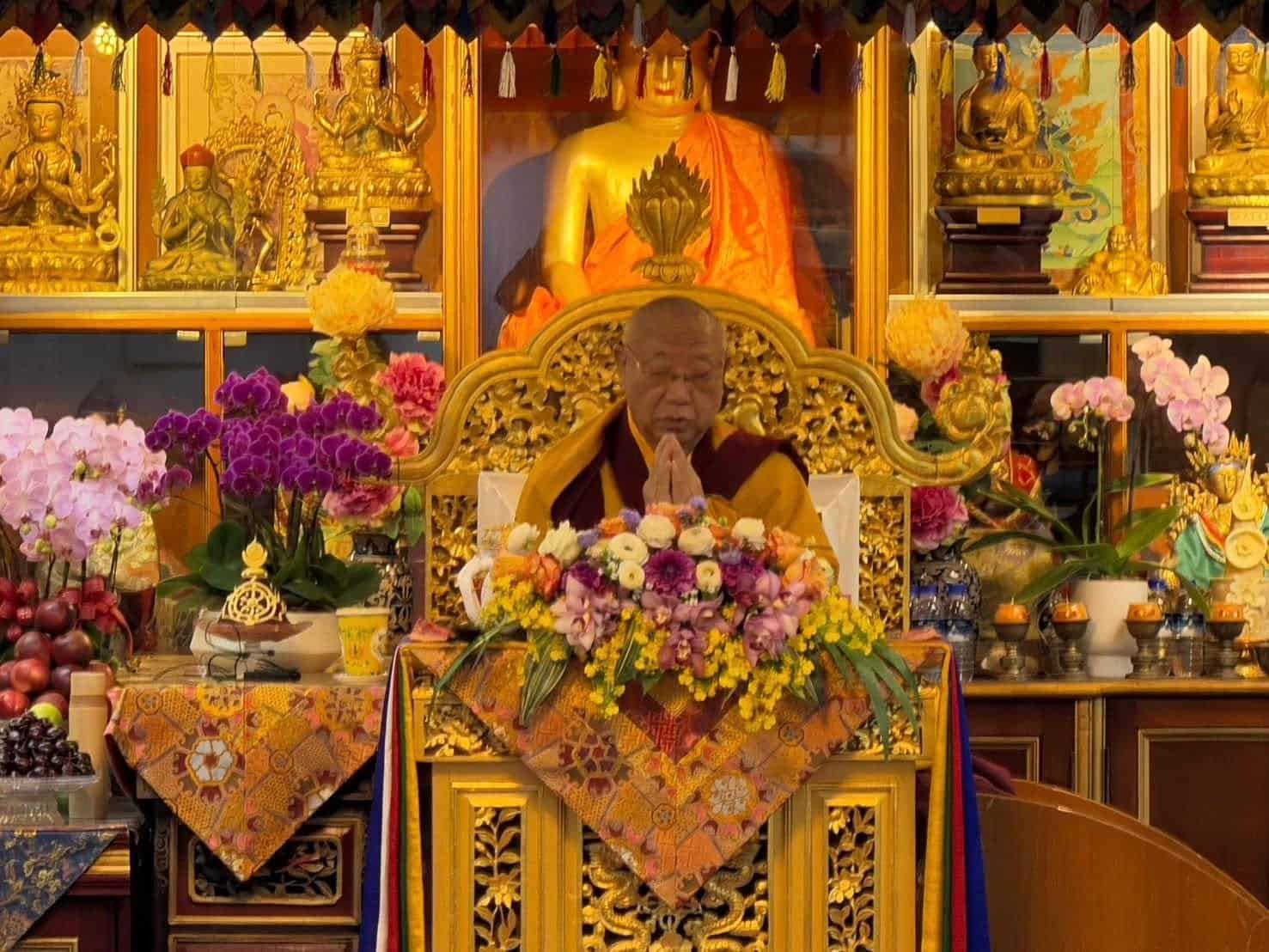
Gosok Rinpoche – Tara Four Mandala Offerings Teaching
2020-12-20 Taipei
Hello everyone, today you have gathered here for a group practice Dharma assembly out of your aspiration for Dharma. You have asked me to say a few words in the middle of the session, hoping that it will help all the practitioners who regularly study and cultivate Dharma to enter properly into the practice of the righteous path. So, consider this as a way for me to refresh your memory. Even though all of you already understand, it is always beneficial to remind ourselves of Dharma. It has been a long time since we last met, so I am very happy to see you all here. First, I wish everyone auspiciousness and well-being.
When we talk about studying and practicing Dharma, it is not just about reciting scriptures alone or participating in group practices. We have 24 hours in a day, so we should try our best to keep our minds engaged in virtuous activities throughout the entire day. Otherwise, if we only engage our minds in virtuous activities for a few minutes, while allowing them to follow unwholesome actions for the remaining 23 hours, it will be very difficult for our practice to gain strength. This is mainly because the power of afflictions and negative karma in our mind-stream is extremely strong. If we want to rely solely on a short period of time and minimal effort to counteract these forces, it would be extremely difficult. This is why we must find ways to engage our minds in virtuous activities for more of the 24 hours, and reduce the time spent on unwholesome activities.
Therefore, in all our activities — walking, standing, sitting, and lying down — we should try to direct our minds toward virtuous activities. As Milarepa said: “Sometimes when sleeping, I practice in sleep; in the state of sleep, ignorance transforms into great luminosity. Such pith instructions I possess.” Even during sleep, we can direct our minds away from unwholesomeness and toward virtue, entering into a state of luminosity while sleeping. In this way, sleep itself becomes a form of practice, with the awareness of luminosity as emptiness. This is the key to transforming sleep into a virtuous activity.
He also said: “Sometimes when eating, I practice during meals; when practicing during meals, it is like a feast offering. Such pith instructions I possess.” We can also practice during meals, just as we often contemplate “food yoga” in daily life. If we practice well, we can accumulate vast merit. This is the key to transforming meals into a feast offering. All such practices can be part of Dharma cultivation. Therefore, no matter when — whether during conversations with others, or while working at the office facing different people — we should try our best to prevent our minds from engaging in unwholesomeness. Always maintain an altruistic mind and bodhicitta when interacting with others, directing our minds toward virtue. In summary, all activities—walking, standing, sitting, lying down—should be directed toward virtuous ends as much as possible.
In other words, we should strive to direct our three doors of body, speech, and mind toward virtue. But let us reflect on our usual conduct of these three doors. What is the actual situation? The word “Dharma” inherently contains the meaning of transformation or correction. Therefore, learning Dharma means we must change. Since beginningless time, we have been controlled by the three poisons of afflictions and have not been free. That is why we continue to wander in samsara and endure suffering. On the other hand, the Buddha and countless past Buddhas relied on many difficulties, renounced self-interest, cherished others, practiced bodhicitta and emptiness, and thus attained perfect Buddhahood. We, on the contrary, remain trapped in samsara.
Therefore, we need to understand that the purpose of studying and practicing Dharma is to change the way our three doors have followed afflictions in the past. If we can bring about this change, then what we are practicing is truly the “Dharma.” Otherwise, we will continue to drift in samsara. No matter how many profound mantras we recite, it will be very difficult for them to generate power. Normally, we may perform prostrations with our bodies, recite mantras or sutras with our speech, or read texts like the Heart Sutra that contain profound teachings on emptiness. However, if we find that during times when we are not practicing, we are still unable to counteract the three poisons, pride, jealousy, and so on, it means that these practices have not been effective — they have not achieved the intended goal of counteracting afflictions. In fact, whether it is performing prostrations with the body or reciting sutras and mantras with speech, the main effort to counteract afflictions must come from the mind. We must first cultivate the mind, and then allow that cultivation to manifest through our body and speech.
Throughout the day, most of our time is controlled by the three poisons (ignorance, attachment, and aversion). Only when we begin to practice or listen to Dharma does it seem that there is an opportunity for the power of these inner afflictions to diminish relatively. This is absolutely necessary because the true practice of countering afflictions occurs at this moment. During these one or two hours of practicing Dharma, we should train our minds.
Therefore, if during the cultivation of renunciation and bodhicitta, our minds are still under the control of afflictions, then it becomes extremely difficult to practice effectively. Thus, we must be extremely cautious and careful. We should diligently cultivate renunciation and bodhicitta during practice and apply the strength gained from such practices to daily life without letting it wane. This is the purpose of practicing Dharma.
In fact, physical and verbal practices are relatively easy; what is more difficult is the practice of the mind. The key to studying and practicing Dharma lies in training the mind. It can be said that the strength of our faith in the Three Jewels and belief in karma determines the quality of our practice results. Therefore, as mentioned earlier, it is crucial to strive to change our minds, as this is fundamental.
The sublime Dharma of the Buddha is truly admirable and inconceivable. Our ability to encounter it or even just hear about it can be considered extremely fortunate, a good result of accumulating vast merit in the past. Therefore, we should seize this opportunity, contemplate frequently on Dharma teachings we have heard, and put them into practice. We should integrate listening, contemplating, and practicing without separation.
Whether it is the commonly recited Heart Sutra or the Eight Thousand Verses of Prajnaparamita, or the profound teachings of the Vajrayana such as Chakrasamvara, Guhyasamaja, and Yamantaka, we should genuinely engage in their practice and achieve their essence. Regarding the supreme methods of the Vajrayana, they possess the power to enable us to attain the fruition of Vajradhara within this very lifetime. However, whether they truly have this power ultimately depends on ourselves.
Similarly, the broader Mahayana teachings are also profound and possess the power to lead to rapid enlightenment. But whether they generate this power depends on whether we have sufficient patience and diligence and whether we have properly rooted ourselves in the cultivation of renunciation and bodhicitta.
Additionally, in “The Guru Yoga of Tushita Heaven,” we recite praises of Tsongkhapa’s great deeds: “In this degenerate age, he diligently practiced hearing and contemplation, did not waste his precious human life, and abandoned the eight worldly concerns. We wholeheartedly rejoice in the vast deeds created by the Lord.” Practitioners should emulate Tsongkhapa in abandoning attachments to the eight worldly concerns, fully dedicating themselves to enhancing their practice, and achieving the essence of the path, which is of utmost importance.
Practicing the pure Dharma is very important for us. It is rare to obtain a precious human life in this lifetime, encounter the Buddha’s teachings, and meet Mahayana spiritual teachers, all of which provide excellent opportunities. Therefore, we must practice diligently. Death is certain to come, and everyone will depart within a hundred years, though we cannot predict when. Thus, we should not delay or slack off in our practice any longer. We should distance our minds from attachments to the eight worldly concerns and enter into the practice of the pure Dharma.
For example, coming to participate in today’s group practice session should not merely aim to avoid illness or obstacles. We should understand that obtaining this precious human life and failing to use it well for practicing Dharma would be an immense pity. To practice Dharma well, we need longevity, health, and freedom from obstacles, which is why we attend such gatherings. In other words, the purpose of attending these gatherings is to practice Dharma well.
If participation is driven by attachment to this life or the pursuit of worldly concerns, it certainly does not count as practicing the pure Dharma. In summary, since we have obtained this precious human life and death is inevitable, we must determine to practice Dharma. Since we cannot predict when death will come, we should not delay practicing any further but should decide to start immediately. Additionally, we must recognize that only through Dharma can we attain eternal benefits. Therefore, whether it is work or health, we must understand that the ultimate goal of everything is to practice Dharma well. Recognizing this principle and focusing our minds on it is very important. I hope everyone will make extra efforts in daily practice. What we look forward to is exactly this. Thank you.