
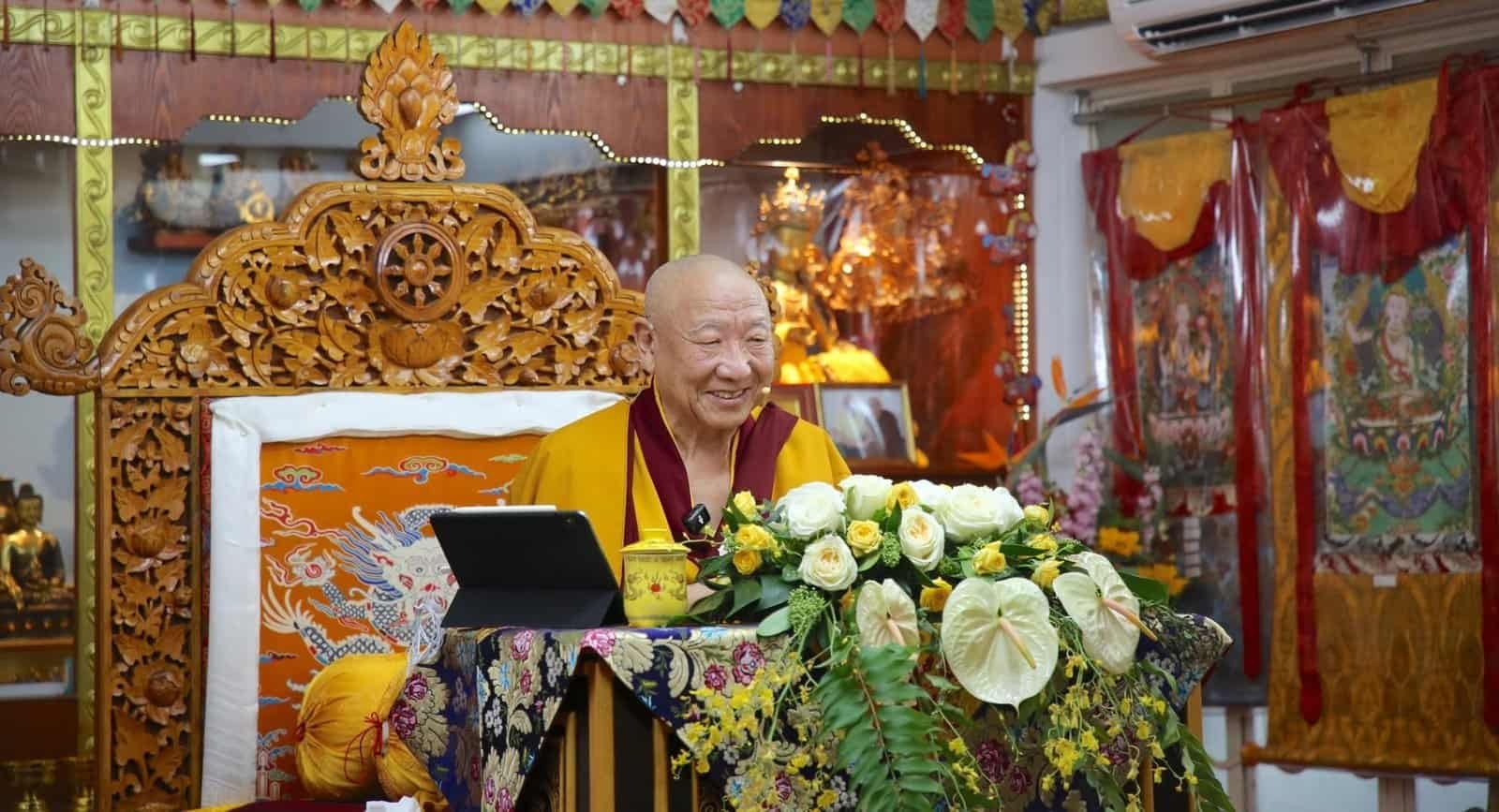
April 8, 2026 – Day One
Today we will teach the *Thirty-Seven Practices of a Bodhisattva*. Its main purpose is to instruct us on how to generate bodhicitta and how to uphold the bodhisattva vows.
The term “Buddha’s Child” (Tib. *Gyalse*) literally means “prince” or “son of the victorious one.” This does not mean that the author, the bodhisattva Gyalse Tokme Zangpo, himself came from a royal family.
The profound meaning is that an ordinary practitioner, once they generate bodhicitta, practice accordingly, and uphold the bodhisattva vows, can truly be called a “Child of the Buddha.”
The Thirty-Seven Practices of a Bodhisattva teaches us how to act. If we have taken the bodhisattva vows and wish to generate bodhicitta, how should we practice? Through the study and cultivation of the Tripitaka—the Sutras, Vinaya, and Abhidharma—and then bringing forth the practice of the Three Trainings—discipline, meditative concentration, and wisdom—within our mindstream.
What is the purpose of our practice? It is to generate the qualities of the Five Paths and the Ten Bhumis within our mental continuum. Of course, bringing forth these qualities is not easy, just as it is not easy to subdue our afflictive emotions. Therefore, the purpose of our listening today is to engage in practice. How do we practice? By finding ways to generate bodhicitta within ourselves. Thus, we approach today’s session with a Mahayana motivation—an attitude embraced by bodhicitta—as the preliminary for listening to the teachings.
Due to time constraints today, we will not elaborate on the life stories of the text’s author, the master Tokme Zangpo, so as not to delay the translation. We will proceed directly to the root text.
The *Thirty-Seven Practices of a Bodhisattva* tells us how to engage in bodhisattva conduct, meaning how to practice it genuinely. When listening to the teachings, we must accomplish:
1. A pure motivation at the beginning,
2. A pure main practice in the middle,
3. A pure dedication at the end.
The preliminary section is divided into two parts: the homage verse and the statement of the purpose of composition. (These two parts are not counted among the root verses of the Thirty-Seven Practices of a BodhisattvaThe homage begins with the Sanskrit words: Namo Lokeshvaraya (Tib. Namo Lokeśvarāya), which means “Homage to the Lord of the World,” directly translated as “Homage to Avalokiteśvara.” This refers to the embodiment of the compassion of all buddhas, the Great Compassionate One, Avalokiteśvara.
The treatise The Thirty-Seven Practices of a Bodhisattva teaches us how to cultivate bodhicitta just like Avalokiteśvara. Therefore, from the very beginning, we pay homage to Avalokiteśvara with a heart of devotion.
Why does the text open with Sanskrit? The primary purpose is to show that we are following the teachings of the Buddha. By beginning in Sanskrit, the author indicates: “What I am explaining is not something I have invented myself; it has been transmitted from the Buddha down to the present, and I also quote the explanations of the Indian masters.” This demonstrates the purity and authenticity of the lineage.
Though seeing all phenomena as neither coming nor going,
You strive solely for the welfare of beings.
Before the Guru and Lord Avalokiteśvara,
I constantly pay homage with my three doors of body, speech, and mind.
The essential meaning of the homage verse is to supplicate while regarding the guru and the deity Avalokiteśvara as inseparable. “Though seeing all phenomena as neither coming nor going” refers to Avalokiteśvara, who, with the wisdom that realizes emptiness, perceives all phenomena as lacking inherent nature. Yet, despite having directly realized emptiness, the sole endeavor in which he tirelessly engages is benefiting all sentient beings. Therefore, my spiritual master and the deity Avalokiteśvara, who is the compassionate manifestation of all buddhas, are essentially non-dual. Thus, at all times, with my three doors of body, speech, and mind, I sincerely and respectfully supplicate them.
This verse indicates “realizing emptiness,” which refers to the direct, personal realization of emptiness abiding in the state of meditative equipoise. And while in meditative equipoise, one can still benefit beings; this shows that the wisdom of meditative equipoise and subsequent attainment are non-dual in essence and exist in union. However, this state of inseparable union of equipoise and subsequent wisdom is fully perfected only at the level of buddhahood.
Whatever realization or qualities we wish to generate in our mindstream, we must rely on the guru who is inseparable from the deity, and develop firm faith in him. The depth and breadth of all realizations depend entirely on the degree of our faith in the guru.
Just like the example of the great master Naropa, in all our practices we should regard the guru and the deity as inseparable. If a thought arises that the deity is superior to the guru, or that there exists a deity surpassing the guru, then at that very moment, no qualities can arise in our mindstream.
Why? The guru or spiritual friend is the guide who leads us along the path to liberation and enlightenment. It is like traveling in the world: if we wish to go to a place we have never been, we must rely on a guide to show the way. Similarly, the path to liberation and enlightenment is a terrain we have never traversed; without the guru’s guidance, we can never reach it.
Again, consider crossing the ocean in a boat. The ocean represents the sufferings of samsara; wishing to escape the ocean of samsaric suffering is like wanting to cross to the other shore. To accomplish this, we must rely on an experienced boatman to navigate and ferry us across. Likewise, in going from the state of an ordinary being to the far shore of freedom from samsaric misery, we need a guide who is like that boatman—and that is the guru. This shows that the guru is extremely important. Therefore, we should supplicate while regarding the guru as inseparable from the noble Avalokiteśvara.
The perfect buddhas, source of benefit and happiness,
Are born from having accomplished the sacred Dharma.
And that accomplishment depends on knowing the practices;
So I will explain the bodhisattvas’ practices.
After explaining the homage verse, we come to the purpose of composing the treatise: All sources of benefit and happiness come from the perfectly enlightened buddhas. Why? Because if we wish to attain happiness, we must create virtuous karma. How do we know that through performing virtue we can obtain happiness? Primarily through the Buddha. With his wisdom dharmakaya as the empowering condition, he manifests as the nirmanakaya and teaches us the Dharma, so that we can understand how to practice.
So how did the buddhas themselves attain enlightenment? They were born from accomplishing the sacred Dharma. To achieve buddhahood, the buddhas also had to practice the sacred Dharma; it is through genuine practice that they obtained the perfectly enlightened body of a buddha.
How, then, should we practice the Dharma? “That accomplishment depends on knowing the practices.” If we wish to study and practice the sacred Dharma, we must likewise rely on the Buddha’s teachings. Only through the Buddha’s instructions can we grasp the essential points of practice. Therefore, what is it that I, the master Tokme Zangpo, need to do now? “So I will explain the bodhisattvas’ practices.” That is, he tells us: If we wish to attain the same state as the Buddha, we must understand how to put into practice the various conducts of the Buddha’s children—the bodhisattvas.
With this, we have concluded the “preliminary” section. Next, we enter the “main body,” which formally expounds the content of the treatise. In explaining the treatise’s meaning, there are three outlines:
The preliminary section covers seven topics in seven verses:
Having gained this supreme vessel of leisure and endowments, so difficult to find,
To liberate oneself and others from the ocean of birth and death,
Without wasting day or night,
To study, reflect, and meditate—this is the practice of a Bodhisattva.
The line “Having gained this supreme vessel of leisure and endowments, so difficult to find” refers to the fact that in this lifetime we have, with great difficulty, obtained the precious human life of leisure and endowments that enables us to study and practice the sacred Dharma. “Leisure and endowments” means being free from the conditions that oppose Dharma practice—the eight states of no leisure—and simultaneously possessing the favorable conditions for practice—the ten endowments. Having obtained such a human life of leisure and endowments, what should we do with it? We must help ourselves and others to cross the ocean of samsaric suffering.
And how do we help ourselves and others to be liberated from the ocean of birth and death? The verse says, “Without wasting day or night,” which means constantly and diligently striving throughout the six periods of the day and the six periods of the night. What is the content of this diligent striving? It is to listen to the sacred Dharma in the presence of a qualified spiritual teacher. Through listening, the wisdom of hearing arises. Once we have the wisdom of hearing, we then engage in repeated analysis and contemplation, giving rise to the wisdom of reflection. The wisdom of reflection means that, by repeatedly pondering what we have heard, we develop a decisive certainty within our mind. Once this certainty is established, we familiarize ourselves with it again and again, until we bring forth the wisdom of meditation. Therefore, from the very beginning, we must undertake the study of hearing, reflection, and meditation under a qualified spiritual teacher. This is the meaning of “to study, reflect, and meditate—this is the practice of a Bodhisattva.”
Why is the human life of leisure and endowments so extremely difficult to obtain? The line “Having gained this supreme vessel of leisure and endowments, so difficult to find” expresses that obtaining this human body is a matter of great fortune, likened to a ship that can ferry us across the ocean of birth and death. The reasons for its rarity lie in the need to gather three causes:
Only by perfecting these three conditions can we obtain a human life of leisure and endowments. However, after obtaining such a life, we should not think only of freeing ourselves from the ocean of birth and death; we must also think: I must help all mother sentient beings to cross the great ocean of cyclic existence.
First, “pure moral discipline as the foundation.” Pure moral discipline refers to the pratimoksha vows, the bodhisattva vows, and the tantric vows that we have taken. After receiving these vows, are we able to uphold them properly? This is the basis.
Second, “the six perfections, such as generosity, as supportive conditions”—that is, the practice of the six paramitas: generosity, discipline, patience, diligence, and so forth. Have we ourselves properly engaged in the practice of the six paramitas? Have we properly guarded our vows? If we reflect and examine our own conduct, we will realize that it is not easy.
Third, “vast, stainless, and pure prayers of aspiration.” “Stainless pure prayers” does not mean hoping to use virtuous actions such as keeping discipline and practicing generosity merely to obtain long life, freedom from illness, or wealth in this lifetime; these are not stainless pure prayers. Stainless pure prayers refer to pure aspirations—not only for oneself, but for all sentient beings to attain the state of buddhahood. This alone is a truly stainless pure prayer.
As stated in the Bodhicaryavatara (A Guide to the Bodhisattva’s Way of Life), the human life of leisure and endowments is difficult to obtain because its causes are difficult to gather. By examining our own actions in this life, we can understand that this human body is indeed obtained with great difficulty. Therefore, having obtained such an exceptionally rare human body, we must never think only of our own welfare, but rather keep all sentient beings in mind. To help all sentient beings cross the ocean of cyclic existence, we must not let day or night pass in vain—that is, we must strive diligently day and night.
So, how should we strive day and night? By engaging in the practice of study, reflection, and meditation. Why are study, reflection, and meditation so important? The scriptures explain that if we do not listen to the teachings, it is like having no hands and wanting to climb a mountain. Without hands, how can we climb a high mountain? Similarly, if we have not listened to the teachings and yet say we want to practice, we simply will not know how to practice. Therefore, we must first place great importance on listening. After listening, we will know how to practice.
However, can we fully understand everything just by listening? No, we cannot. Because after listening, we only grasp a general meaning. After understanding the general meaning, we must engage in repeated contemplation and analysis.
The first stage is listening, which gives rise to the wisdom of hearing. The wisdom of reflection comes from continuously thinking, continuously examining and investigating, until we arrive at a decisive understanding of what we have heard—that is, until certainty is born. Once certainty is born, we are able to practice with greater energy and resolve. But certainty alone is not enough; we must then cultivate repeated familiarization, over and over again. This is what is called the wisdom of meditation. Therefore, how should we proceed with our practice? By following this progressive sequence—study, reflection, and meditation—and putting them into practice step by step.
Attachment to loved ones surges like water,
Hatred towards enemies blazes like fire,
Through ignorance, what to adopt and abandon is obscured by darkness —
To leave one’s homeland is the practice of a Bodhisattva.
This is the second verse, and its theme is “leaving one’s homeland,” meaning to distance oneself from one’s native place.
Towards what objects do we generate attachment? We very easily develop attachment towards those we regard as relatives or as belonging to the side of loved ones. When such attachment arises, it is like being caught in a flood — it is not easy to free oneself from the water. Thus, the attachment we feel for friends and relatives is like water.
“Hatred towards enemies blazes like fire.” Here, “enemies” refers to adversaries. Towards our enemies, we easily generate hatred, and this hatred is like a great fire. When we become angry, our body heats up, as if burning. So, towards those with whom we are incompatible — those we classify as objects of hatred or enmity — we naturally give rise to aversion. Therefore, hatred is likened to fire.
“Through ignorance, what to adopt and abandon is obscured by darkness.” Ignorance refers to the dullness we easily fall into regarding objects that are neither objects of attachment nor aversion. Why is it called ignorance? Because when facing such objects, we find it difficult to sustain mindfulness; our mindfulness fades and disappears. Ignorance is like darkness, for it prevents us from generating the mindfulness needed to hold our own minds, just as darkness obscures vision.
“To leave one’s homeland is the practice of a Bodhisattva.” Generally, when we speak of “homeland,” there are two ways of understanding it. The first refers to the place where our parents gave birth to us and where we live — this is called one’s homeland or native place. The second interpretation refers to the place where attachment, aversion, and ignorance arise. Why do we wander in samsara, continuously remaining within cyclic existence? It is precisely because attachment, aversion, and ignorance arise. Therefore, the place where the three poisons arise is called one’s homeland. And the arising of the three poisons is the greatest obstacle to studying and practicing the Dharma.
Hence, “to leave one’s homeland is the practice of a Bodhisattva” tells us: the attachment we generate towards those we favor, the hatred we generate towards our enemies, and the ignorance we generate towards what we do not understand — these three poisons are what we must counter and overcome. Thus, “leaving one’s homeland” refers to the practice of distancing oneself from the three poisons of attachment, aversion, and ignorance. This is the genuine practice of a Bodhisattva.
By avoiding harmful objects, destructive emotions gradually diminish;
Without distraction, virtuous practice naturally increases;
With clarity of mind, certainty in the Dharma is born —
To rely on solitude is the practice of a Bodhisattva.
Earlier, we spoke of needing to leave the “homeland” of attachment, aversion, and ignorance. So, where should we go after that? We should go to a place of solitude — a place that can help us reduce the three poisons.
Why do attachment, aversion, and ignorance arise in the first place? It begins with the objects we encounter. Towards pleasing objects associated with loved ones, attachment arises; towards unpleasant, undesirable objects, aversion arises. Therefore, first we must distance ourselves from these harmful objects that provoke attachment and aversion.
After distancing ourselves from the objects that provoke the three poisons, naturally “destructive emotions gradually diminish” — the word “delusions” here refers to the afflictive emotions. Our afflictions will naturally and gradually subside. Once afflictions diminish, we naturally become free from distraction, and our mind becomes increasingly clear. When we distance ourselves from afflictions, the mind no longer scatters. When the mind is undistracted, we can naturally achieve “clarity of mind” — the meaning of “clarity” is that the mind is pure. Once the mind becomes pure, we naturally find it easier to develop certainty in the Dharma, in the teachings we study, reflect upon, and meditate upon — to give rise to decisive insight.
This sequence is the very opposite of the process of affliction arising explained in the *Abhidharmakosha*. The *Abhidharmakosha* states that when we encounter the three types of objects that give rise to attachment, aversion, and ignorance, afflictions naturally arise. Once afflictions are present, we easily engage in inappropriate mental attention. Once inappropriate attention has taken hold, the mind naturally becomes more and more scattered.
Here, the reverse is presented. How do we distance ourselves from afflictions? First, we must leave behind the harmful objects that cause attachment, aversion, and ignorance to arise. Once we are far from these harmful objects, afflictions decrease. When afflictions decrease, the mind naturally becomes undistracted. When the mind is undistracted, it naturally purifies easily. When the mind is pure, we are able to gain certainty regarding all phenomena. Thus, the verse tells us that we should practice in a place of solitude — this is the practice of a Bodhisattva. A place of solitude is a place free from the objects that provoke attachment, aversion, and ignorance.
This is like the instruction that Lama Tsongkhapa gave to his disciples in The Three Principal Aspects of the Path:
Thus, if you have genuinely comprehended the essential points of these three principal paths,
Rely on a place of solitude and generate joyous effort.
May you swiftly accomplish the ultimate goal.
This means that, having comprehended the essential points of renunciation, bodhicitta, and the correct view of emptiness — the three principal paths — and having understood their importance through study, reflection, and meditation, you should then go to a solitary place — that is, a place far from the objects that provoke the three poisonous afflictions — and practice with great diligence. Through such diligent practice, may you, the disciple, swiftly attain the ultimate fruition, the accomplishment of buddhahood.
From this, we can see that both Lama Tsongkhapa and the master Tokme Zangpo are telling us about the many benefits and advantages of relying on a place of solitude.
Long-acquainted companions and loved ones must part;
Wealth and possessions, amassed through effort, are finally left behind;
The guest, consciousness, must abandon the inn of the body —
To renounce the concerns of this life is the practice of a Bodhisattva.
This verse tells us that “long-acquainted companions and loved ones must part.” When relatives and close friends gather together, the time will inevitably come when they must separate; they cannot stay together forever without parting.
“Wealth and possessions, amassed through effort, are finally left behind.” The riches we spend our whole lives striving to accumulate, when the day of death arrives, we cannot take a single thing with us; ultimately we must abandon them. Even if we wish to take them, it is simply impossible. And going further, it is not only external friends and relatives or material wealth —
“The guest, consciousness, must abandon the inn of the body.” In this verse, the mind is likened to a traveler or guest, and the body is likened to a hotel or inn. When the day of death comes, the consciousness must still leave behind this body, which is like a guesthouse. We cannot take anything with us; we go on to the next life completely alone.
Therefore, this verse teaches the concept of “death and impermanence.” Each of us knows that death is certain, but have we truly and earnestly contemplated this matter? This verse tells us to reflect carefully and to generate a firm conviction within our minds: I should not be attached to the various things of this present life. I must distance myself from the thoughts that give rise to attachment and aversion, and from the objects that provoke them — because there is no need to cling to them. Why? Because when death arrives, even if you desperately wish to take them, you cannot take a single thing.
Hence, “to renounce the concerns of this life is the practice of a Bodhisattva” — this is the conduct of a bodhisattva. However, a special clarification is needed here: “Renouncing the concerns of this life” does not mean that we abandon all the food, clothing, and necessities we use right now. That is not the meaning. What is to be renounced here is the mind of attachment. Some people misunderstand the meaning of “renouncing this life,” thinking it means having no regard at all for worldly necessities — not eating, not wearing clothes, not wanting any comforts, or just letting a fire burn you or letting yourself drown if you fall into water. But that is not the point here. What is to be abandoned here is our attachment.
Why must we abandon attachment? Because we do not know whether tomorrow or the next life will come first. Since we cannot be sure which will arrive first — tomorrow or our future life — why should we cling to the things of this present life? Therefore, what is meant here is to aspire for future lives and to renounce the concerns of this life, and the real key point is to renounce our attachment.
When keeping company with someone causes the three poisons to increase,
Destroys the activities of study, reflection, and meditation,
And causes loving-kindness and compassion to be lost —
To abandon such harmful friends is the practice of a Bodhisattva.
This is the fifth verse, and its topic is the abandonment of harmful friends. The verse says: “When keeping company with someone causes the three poisons to increase, destroys the activities of study, reflection, and meditation, and causes loving-kindness and compassion to be lost — to abandon such harmful friends is the practice of a Bodhisattva.”
What is meant by a “harmful friend”? It refers to a person with whom, after spending a long time together, our three poisons will grow. That is to say, when we keep company with such a person for a long time, the three poisons of attachment, aversion, and ignorance in our mindstream gradually increase. Or, “destroys the activities of study, reflection, and meditation” — after being with this person for a long time, our practice of studying, reflecting, and meditating upon the Dharma slowly degenerates. Also, “causes loving-kindness and compassion to be lost” — the very root of the Mahayana is great loving-kindness and great compassion. If, after staying with this person for a long time, our loving-kindness and compassion gradually diminish, the very foundation of the Mahayana is lost. When we notice such signs, we know that this type of person is what is called a “harmful friend.” Thus, “to abandon such harmful friends is the practice of a Bodhisattva” — distancing oneself from harmful friends is the conduct of a bodhisattva.
The “harmful friends” we are to abandon here refers specifically to those who cause our Mahayana motivation to degenerate; they are the objects we should relinquish.
Why must we abandon harmful friends? Because we are beginner practitioners. We have just begun to study and practice the Dharma, and our minds are not yet stable — they are easily destroyed, easily influenced by others, and easily altered as a result. Therefore, the master Gungtang Rinpoche once said that a harmful friend is not someone with horns growing from their head and fangs — that is not the image. A harmful friend means someone who makes our conduct increasingly worse. As stated in *The Thirty-Seven Practices of a Bodhisattva*, if associating with someone causes our three poisons of attachment, aversion, and ignorance to grow, destroys our practice of study, reflection, and meditation, and causes the loving-kindness and compassion in our mindstream to slowly fade away, such a person is what is called a harmful friend, and they are the object we must abandon.
When relying on someone, our negative actions gradually fade away
And good qualities increase like the waxing moon —
To cherish such a spiritual friend even more than one’s own body
Is the practice of a Bodhisattva.
Earlier, we discussed abandoning harmful friends. After that, whom should we draw close to? We should draw close to spiritual friends, that is, spiritual teachers. When we stay near and rely upon such a person, the negative karma of the three poisons — attachment, aversion, and ignorance — slowly recedes, and our good qualities increase and become complete, just like the moon waxing from the first day of the lunar month to the fifteenth.
“To cherish such a spiritual friend even more than one’s own body” — we come to cherish and care for others even more than we cherish and care for ourselves. Such a person is a spiritual teacher upon whom we can rely. Therefore, relying on a spiritual teacher is one of the important practices of a Buddha’s child, a bodhisattva.
A spiritual teacher is someone who enables our good qualities to continuously increase and our negative actions to continuously diminish. However, when we rely on a spiritual teacher, sometimes because we have not cultivated faith in the teacher, we may notice faults in them. So, when we perceive faults in our spiritual teacher, how should we reflect? We should think: “The appearances I perceive are not necessarily definitive” — what I see may not be correct. In addition to reflecting in this way, in all our actions, we should do that which pleases the spiritual teacher.
As emphasized right from the beginning in the *Lamrim*, the importance of “relying on the spiritual teacher” is the very root of spiritual practice.
Themselves imprisoned in the prison of samsara,
How can worldly gods protect anyone?
Therefore, to take refuge in those who do not deceive —
To take refuge in the Three Jewels is the practice of a Bodhisattva.
This is the final part of the preliminary section, the seventh topic: taking refuge in the Three Jewels.
We have fallen into the cycle of birth and death. Who can truly protect and save us? As for the worldly gods, they themselves are likewise imprisoned in the jail of samsara. They themselves are unable to escape from this prison of birth and death. It is like a drowning person — they are themselves in the water, about to drown, and have no way to save themselves. How could they possibly save another drowning person? By the same reasoning, the worldly gods themselves are still within cyclic existence, not yet liberated from samsara. So how could they possibly rescue me, who wishes to be freed from samsara?
Then who can become our true protector and refuge? It is the Three Jewels: the Buddha, the Dharma, and the Sangha. The Three Jewels alone are the truly supreme objects. Why are they called supreme? “To take refuge in those who do not deceive” — because the Three Jewels have actually, truly liberated themselves from cyclic existence. The Buddha, through cultivating the sacred Dharma, attained the non-abiding nirvana. Therefore, he has the capacity to save all sentient beings, to lift us out from samsara. Thus, taking refuge in the Three Jewels is the practice of a Bodhisattva.
We have now concluded the preliminary section. Next comes the main body. The main body is further divided into three outlines: the practices of the being of lesser capacity, the being of middling capacity, and the being of greater capacity.
The utterly unbearable sufferings of the lower realms
Are taught by the Mighty One to be the fruits of negative actions.
Therefore, even at the cost of one’s life,
Never to commit negative actions is the practice of a Bodhisattva.
The eighth verse presents the practices of the being of lesser capacity.
The sufferings of the three lower realms are extremely difficult for us to endure. Regarding the hell realms, there are the cold hells and the hot hells, where beings must undergo the torments of extreme cold and extreme heat. The hungry ghost realm is the suffering of hunger and thirst, perpetually tormented by an empty stomach and parched mouth year after year. The animal realm is the suffering of ignorance. Whichever of the three lower realms one is born into, the suffering is beyond our ability to bear.
Why do we fall into the three lower realms? “Are taught by the Mighty One to be the fruits of negative actions” — it is because we have committed negative karma that we fall into the lower realms. Heavy negative karma leads to birth in the hell realms, middling negative karma leads to birth among the hungry ghosts, and lighter negative karma leads to birth as an animal. Therefore, if we do not wish to fall into the three lower realms, “even at the cost of one’s life, never to commit negative actions” — even if our life is in danger, even if we face life-threatening circumstances, we must not commit the negative actions that would cause us to fall into the three lower realms. Thus, refraining from negative actions is the conduct of a Bodhisattva.
What this verse tells us is that we must abandon negative karma. If we do not abandon negative karma, we will have no way to free ourselves from the utterly unbearable sufferings of the three lower realms.
So, how should we go about this practice? From the very beginning, we must first contemplate: I have now obtained the precious human life of leisure and endowments, so difficult to find. But after obtaining this human life of leisure and endowments, it is not something solid and indestructible. Therefore, from this we contemplate death and impermanence, because every one of us will face death. After death, our consciousness does not simply vanish. Consciousness will continue to take rebirth, and rebirth has only two directions — either to a happy realm or to a miserable realm.
When we contemplate the lower realms and think about their sufferings, a sense of fear arises in our mind. Then, with the conviction that the Three Jewels alone are our true protection, we sincerely take refuge in the Three Jewels. After taking refuge, we must develop faith in the teachings on karma and its effects as taught by the Buddha. Having developed such faith, regarding what to adopt and what to abandon according to the law of karma — that is, abandoning negative actions and cultivating virtue — we must practice accordingly and properly.
April 9, 2026 – Day Two
Before listening to the teachings, just as we explained previously, we must generate the bodhicitta motivation: “For the sake of all sentient beings, may I attain buddhahood.” With this intention, this motivation, we establish the preliminary for listening to the Dharma. And because we are embraced by bodhicitta, we should ask ourselves: How should I generate bodhicitta? How should I engage in the practices of a bodhisattva? For this purpose, I am here to listen to *The Thirty-Seven Practices of a Bodhisattva*.
Before we can generate the bodhicitta that wishes, “For the sake of all sentient beings, may I attain buddhahood,” we must first generate within ourselves the mind that wishes, “I want to be liberated from cyclic existence.” This is because if we cannot generate the mind of renunciation — the heartfelt wish to free ourselves from samsara — it is impossible for us to then wish for the sake of other sentient beings, to hope to help other sentient beings also become free from samsara.
The pleasures of the three realms are like dew on the tip of a blade of grass —
They are phenomena that perish in but a moment.
Therefore, to generate yearning for the never-changing state of liberation
Is the practice of a Bodhisattva.
In the previous session we finished the path of the being of lesser capacity. Today we begin with the path of the being of middling capacity. As mentioned before, before we can generate bodhicitta, we must first ourselves give rise to renunciation.
Here, “the three realms” refers to cyclic existence, samsara. These are generally spoken of as the desire realm, the form realm, and the formless realm, or as the realms of gods, humans, nagas, and so forth. In brief, the “three realms” encompass everything from the lowest hell up to the Peak of Existence; all of it belongs to the three realms.
The pleasures of the three realms are like “dew on the tip of a blade of grass” — like a drop of dew on a blade of grass, as soon as the sun rises, it quickly vanishes. What we experience within the three realms is in truth the suffering of suffering, the suffering of change, and the all-pervasive suffering of conditioning.
Among these, the suffering of change is what we ordinarily call happiness. But this kind of happiness is contaminated happiness; it is not uncontaminated happiness. Because it is contaminated, it is a phenomenon of destruction, perishing moment by moment. This is not what we should truly aspire for.
What we should aspire for is “the never-changing state of liberation” — the fruit of liberation, which is ultimate happiness. Why is it called “never-changing”? Because once this ultimate happiness is attained, it does not regress. In contrast, contaminated happiness can regress at any time. We may say, “I aspire to the uncontaminated happiness of liberation,” but when we actually seek it, what is it that we pursue? Usually, it is contaminated happiness. If we did not know this, it would be one thing. But if we know that what we truly need to pursue is uncontaminated happiness and yet still seek contaminated happiness, this is a great fault. Therefore, I must generate yearning for the path of liberation; this is what a Bodhisattva should strive for. Hence, “to generate yearning for liberation is the practice of a Bodhisattva.”
We should understand that the happiness of the world — whether it is the happiness of gods or the happiness of nagas — is not ultimate happiness, because by its very nature it remains within cyclic existence. And as long as it is within cyclic existence, its nature of suffering is the suffering of conditioning. Once we know this, what we pursue should no longer be the happiness of the human or divine states; what we truly need to yearn for is the fruit of liberation.
As stated in *The Three Principal Aspects of the Path*:
By thus habituating yourself, you will not generate even a moment of hope
For the splendors of cyclic existence.
The mind that day and night continually yearns for liberation —
When this arises, that is renunciation.
What we should seek is not worldly happiness, but a mind that genuinely wishes to break free from cyclic existence, that yearns for liberation. Before we can give rise to the mind of renunciation that yearns for liberation, we must truly understand the suffering of cyclic existence — not only that of the three lower realms, but also that even within the happy realms, their nature is suffering. Only then can we generate the genuine mind of renunciation that yearns for liberation.
From beginningless time, my mothers have cherished me with loving-kindness.
If they are suffering, how can I be happy?
Therefore, in order to liberate limitless sentient beings,
To generate bodhicitta is the practice of a Bodhisattva.
Now we come to the path of the being of greater capacity, which is divided into two topics:
This verse says that from beginningless time, in all our past lives, every single mother, just like our mother in this present life, has shown us exactly the same kindness and loving compassion. Therefore, I cannot think only of freeing myself from samsara and attaining happiness. I must think of all sentient beings. Because they have all been my mothers, and when they were my mothers, just like my present mother, they cared for me with loving compassion. Thus, I must truly repay their kindness. I cannot think only of my own liberation and leave beings who are just like my present mother to continue experiencing suffering. Therefore, for all mother sentient beings, vast as space, I wish that every one of them be free from suffering and attain happiness. From this arises the mind that thinks, “For the sake of all beings, may I attain buddhahood.”
Why must we generate the mind that thinks, “For the sake of all beings, may I attain buddhahood”? Because if I have developed the wish to help all sentient beings to be free from suffering and attain happiness, how can I accomplish this? First, I must understand all aspects of “the nature as it is” and “the nature in all its variety” — that is, the ultimate reality of phenomena and their manifold particular characteristics. Only when I understand these can I emanate countless boundless manifestations; and only with countless manifestations can I benefit countless sentient beings. Because our object of focus from the very beginning is all sentient beings, vast as space, and since I wish to bring about the happiness of all these beings, I must first possess this capacity. And to possess this capacity, only after I have generated bodhicitta and attained the state of buddhahood can I truly accomplish it. Therefore, generating bodhicitta is the practice that a Bodhisattva must cultivate.
Once we have generated bodhicitta, how should we proceed in our practice? The main reason we are unable to give rise to the mind that cherishes others and wishes to benefit them is the presence of “self-cherishing” in our mindstream.
As stated in the *Guru Puja*:
In brief, the childish work only for their own benefit,
While the Mighty One labored solely for the sake of others.
With a mind that clearly distinguishes their faults and virtues,
I seek blessings to gain the benefit of exchanging self and others.
It is precisely through the practice of “exchanging self and others” that we can purify this fixation on thinking only of ourselves and loving only ourselves, and transform the mind that cherishes self into the mind that strives to benefit all sentient beings and help others. This is the practice of “exchanging self and others.”
All suffering comes from desiring one’s own happiness;
The buddhas are born from the mind that benefits others.
Therefore, to completely exchange one’s own happiness for the suffering of others —
To practice exchanging self and others is the practice of a Bodhisattva.
This verse tells us: why are we suffering so much? Our suffering comes from the fact that we are attached solely to our own happiness, wishing only for ourselves to obtain happiness. Why were the buddhas able to attain enlightenment? Because they generated bodhicitta. So how did they train? They began with the mind that wishes to benefit others. The preliminary to bodhicitta is to first give rise to an altruistic mind, the mind that seeks the welfare of others. Only after that can one generate the bodhicitta that aspires to attain buddhahood for the sake of all beings.
Therefore, we must transform this self-cherishing mind — which only thinks of itself — into the mind that benefits others. “Therefore, to completely exchange one’s own happiness for the suffering of others” — at this point we must switch. Ordinarily, we think only of our own happiness and disregard others. Now we reverse it: we give our happiness to others, and we take upon ourselves the suffering of others. Thus, “to practice exchanging” means to practice exchanging self and others. This is precisely the conduct that a Bodhisattva must train in.
In our daily practice, we must contemplate the faults of self-cherishing and the good qualities of cherishing others, reflecting on them again and again. How should we reflect? Because we have only thought of ourselves and disregarded others for such an immeasurably long time, the buddhas have all attained enlightenment, yet we are still wandering in samsara. This is entirely due to self-cherishing. Look at the teacher, Shakyamuni Buddha, and all the buddhas of the past. Why were they able to attain buddhahood? It is because they abandoned the self-cherishing that cares only for oneself, and completely gave rise to the altruistic mind that strives to bring about the happiness of others. Therefore, they have now achieved the state of buddhahood. Through this, we contemplate the faults of self-cherishing and the good qualities of the mind that cherishes others.
As it is said in the *Guru Puja*:
Again and again, I pray to you, compassionate and venerable gurus:
Whatever sufferings and obstacles there are of mother sentient beings,
May all of them ripen upon me right now.
And may I give away my own happiness and virtue to others,
So that all sentient beings may possess happiness. I seek your blessings.
This shows the essential meaning of exchanging self and others. So when we recite the *Guru Puja*, we usually recite this verse three times with sincere and earnest hearts, praying that through the blessings of the spiritual teacher, we may be able to generate genuine exchanging of self and others.
Even if someone, driven by desire, steals or has others steal
All of one’s wealth,
To dedicate to them one’s body, possessions, and the virtues of the three times —
To dedicate everything to them is the practice of a Bodhisattva.
We have learned that we must generate bodhicitta, and we have learned that in our practice we should train in exchanging self and others. So, when we actually put this into practice, how should we proceed? Here, four ways of “transforming adverse conditions into the path” are taught, along with their supportive practices:
– Dedicating to them
– Taking upon oneself their negative actions
– Praising their good qualities
– Showing them even greater respect
When we encounter four kinds of unwanted adverse circumstances, we must transform them into supports for our spiritual path.
The first situation is when someone comes to steal our possessions — whether they steal money or other forms of wealth, whether they steal it themselves or send others to take it. Such a person, driven by desire, personally comes to rob us and steal our property, or has others plunder all our wealth and belongings. When facing such a situation, how should we think?
At this time, even though this person, out of attachment and a harmful intent, has stolen our belongings, we should contemplate: Because he has committed such a negative act — stealing, taking what is not given — he has created tremendous negative karma. Therefore, I must generate compassion for him. Furthermore, I dedicate to him my entire body, wealth, and possessions, as well as all the roots of virtue I have accumulated throughout the three times. This is how we transform the difficulties we encounter into another form of practice — that is, transforming adverse conditions into the path. Therefore, “to dedicate everything to them is the practice of a Bodhisattva” — dedicating everything to that person is the conduct of a Bodhisattva.
Even if, though one has committed no fault whatsoever,
Someone comes and cuts off one’s head,
To feel unbearable compassion for them,
And to take upon oneself their negative deeds — this is the practice of a Bodhisattva.
The second way of transforming adverse conditions into the path: Although we ourselves have not committed any fault or wrongdoing, someone comes to harm us, even to the point of cutting off our head. Towards such a being, how should we direct our mind and thoughts? This person, because he has harmed me and killed me, has created negative karma — and extremely heavy karma of killing. Reflecting upon this, because he has committed such an act of killing, his future fully ripened karmic result will be the suffering of the three lower realms.
Therefore, “to feel unbearable compassion for them” — towards this person who has come to harm me and kill me, I instead generate such intense compassion that I can hardly bear it, wishing that he may be free from such suffering.
When Atisha encountered harm caused by his own karma, he would contemplate: “This is the ripening of negative actions I committed in the past.”
This verse teaches the same principle — why is this person harming me? In truth, it is because I harmed him in a past life, and now in return, he harms me. At such a time, towards this being, I should generate compassion. Because if we give rise to anger, ultimately it is we ourselves who suffer. So, generating compassion for him, we wish that he may not have to experience such fully ripened suffering. Having generated compassion, we further contemplate: May all the negative karma he has created, and all the results of that karma, ripen entirely upon me. Therefore, “to take upon oneself their negative deeds is the practice of a Bodhisattva.”
Even if someone slanders me in every possible way,
Spreading ugly rumors throughout the three-thousand-fold universe,
With a mind of deep compassion,
To praise their good qualities — this is the practice of a Bodhisattva.
The third way of transforming adverse conditions into the path: If someone deliberately seeks to defame and slander me, spreading false accusations about things I have not done — I am not a thief and did not steal, yet they say I did. They use all kinds of means to slander me, ruin my reputation, and spread rumors far and wide.
Even towards such a person, I remain the same: I generate compassion for them, inwardly wishing that they may not have to experience the suffering that results from having created such negative karma. Not only that, I go further and praise whatever good qualities they possess apart from their slander of me, speaking of their virtues. This practice, too, is the conduct of a Bodhisattva.
Even if someone, in the midst of a large gathering,
Exposes my hidden faults and speaks harsh words,
To regard that person as a beneficial friend,
And to show even greater respect — this is the practice of a Bodhisattva.
The fourth way of transforming adverse conditions into the path: When someone, in the midst of a large gathering, verbally attacks me, even using harsh and abusive language to harm me, I should reflect upon how this person is making me understand the importance of practicing patience. Moreover, when he rebukes me in front of others, why do I feel uncomfortable? The main reason is that we have pride — self-importance — within our mindstream. By reflecting in this way, we can recognize that this person is actually helping me to tame my pride, and is also helping me to practice patience.
Therefore, « to regard that person as a beneficial friend » — this person is in fact a spiritual teacher who is helping me to subdue my pride and to cultivate patience. Hence, towards such a person, « to show even greater respect is the practice of a Bodhisattva. » We should respect him and regard him as a spiritual guide who helps us learn to tame pride and practice patience. This is just like the common saying, « Do not strike back when struck, do not curse back when cursed. » These are indeed the practices of a bodhisattva, helping us to train in patience.
Even if someone whom I have cared for like my own child
Regards me as an enemy,
Like a mother whose child is stricken with grave illness,
To have even greater compassion — this is the practice of a Bodhisattva.
The next verse is also another way of training in transforming adverse conditions into the path.
How should we regard others, especially those who harm us? If someone considers me an enemy, I must still generate a kind heart towards that person. This is like when a small child falls ill and the mother cares for him. Because of the illness, the child may have many complaints, much grumbling, and feel extremely uncomfortable both physically and mentally. It is therefore easy for him to speak rudely or even act out physically towards the mother. But how does the mother regard this child? She thinks, « My child is acting this way because he is sick. Therefore, I must take even better care of him so that he can recover quickly. » Similarly, towards those who harm us, we should reflect with this same attitude.
Thus, the verse teaches that we should not regard those who harm us as enemies, but rather view them like our own children, with redoubled care and protection. If through this approach we can swiftly subdue the afflictions in our mindstream, what a wonderful thing that would be. Therefore, « to have even greater compassion is the practice of a Bodhisattva. »
Even if someone of equal or lesser standing,
Out of pride, repeatedly treats me with contempt,
To honor them like a guru,
To constantly hold them in high regard — this is the practice of a Bodhisattva.
The following verse explains: Someone may possess qualities similar to ours, or even inferior to ours, yet they treat us with extreme arrogance, regarding us as lesser and worse than themselves, and with this proud attitude they mistreat us. Towards such a person, we should view them as a spiritual teacher. Contemplate that this person is actually helping to tame our obstacles and to purify our obscurations, which is why they treat us in this manner. Therefore, we should regard such a person as a spiritual teacher, and « to constantly hold them in high regard is the practice of a Bodhisattva. »
The most famous example of this way of practice is the great master Milarepa. During his training, Milarepa encountered many hardships and was treated unreasonably, but the master himself never gave rise to negative thoughts. Instead, he reflected, « These are all spiritual teachers, skillful means for purifying my obscurations. » Thus, not only did he not harbor any resentment, he followed his teacher’s instructions and practiced accordingly. Through this approach, Milarepa ultimately attained the most supreme state of buddhahood.
This verse tells us that however others treat us, we should regard it as their helping us to purify our negative karma and obscurations. We should not, because they harm us, respond by praising ourselves and disparaging others, or by speaking of others’ faults. Doing so makes it very easy to violate the bodhisattva vows, for among the bodhisattva downfalls there is one that is « praising oneself and disparaging others. » This is something we must be particularly careful and mindful about.
Though one may be destitute and looked down upon by others,
Afflicted by grave illness and harassed by demons,
To still take upon oneself the negative deeds and suffering of all beings,
And not to be discouraged — this is the practice of a Bodhisattva.
The eighteenth verse explains: If we find ourselves lacking wealth, of humble social standing, or beset by various serious illnesses and all kinds of disturbances — that is, when we encounter the greatest difficulties and the most intense suffering — how should we think? Although I myself am suffering so much, I must still find a way to contemplate the negative karma and suffering of all sentient beings, and to wish that their suffering may be taken upon myself. We should not allow our mental strength to weaken just because we are experiencing suffering and hardship. Therefore, « not to be discouraged is the practice of a Bodhisattva. »
Why is the emphasis on « not being discouraged »? Because the mind we have generated is the great mind, the great bodhicitta that resolves, « For the sake of all sentient beings, may I attain buddhahood. » With such a tremendously powerful mind as our support, sustaining our mindstream, we should not let our own difficulties cause our mental strength to decline. Many people, when they encounter external difficulties, begin to lose their bodhicitta, thinking, « Never mind benefiting all other sentient beings — I cannot even handle myself. How could I possibly benefit all other beings? » And thus they abandon bodhicitta. Therefore, the verse tells us that whatever difficulties we encounter, we should never allow our mental strength to weaken. On the contrary, we must find ways to summon even greater strength of mind to face them.
The great masters of the past have taught that we should regard adverse conditions as spiritual teachers, because it is precisely due to these adverse conditions that we will genuinely practice the Dharma. Thus, we see adverse conditions as spiritual teachers. Obstacles — that is, the difficulties we encounter — should be seen as exhorting us to create virtue, to perform virtuous actions. When I encounter an obstacle, it is urging me to practice virtue.
Why do these obstacles arise? It is due to past negative karma — the negative actions I myself committed — that these obstacles now appear. In order not to encounter such obstacles again, I must diligently practice virtue. Therefore, obstacles urge me to practice virtue. And suffering is like a broom that sweeps away our past negative karma, because when our suffering ripens, it is the moment when past negative karma is exhausted. The suffering thus matures. By contemplating in this way, we are transforming adverse conditions into the path.
Though one may possess great wealth and fame, be honored by all,
And have riches equal to Vaishravana himself,
Seeing that worldly glory is without true essence,
To abandon pride — this is the practice of a Bodhisattva.
This instruction is presented from the opposite angle. If we ourselves have an excellent reputation, our fame spreading everywhere and receiving the respect of everyone, and our wealth equals that of Vaishravana — needless to say, even if our riches match those of a king or a great merchant, this indicates that we are very wealthy. In such circumstances, we should not, because of our fame, power, and money, look down upon others or despise them. What we must do is abandon pride, not allowing arrogance to arise in our minds. Why? As previously stated, « Seeing that worldly glory is without true essence » — as was explained earlier, worldly happiness is like dew on a blade of grass, of the nature of perishing moment by moment, devoid of any real essence. Therefore, we need not deliberately give rise to pride simply because we possess these fine things of samsara. Hence, « to abandon pride is the practice of a Bodhisattva. »
This verse also tells us that the sign we should display after listening to the Dharma is a peaceful and subdued demeanor, not an appearance of being very impressive or having intense pride after hearing the teachings. If that happens, it indicates that we have not listened to the Dharma properly.
In the past, a spiritual teacher once said that he preferred to remain in a humble state rather than being superior to others. Why? Because when we are in a superior position, pride and jealousy arise very easily. Yet when we find ourselves in a more humble state, it is actually easier to perform virtuous actions.
We can take the example of a beggar — though nowadays it is not so easy to see beggars asking for tsampa. A poor person thinks only of being able to beg for some tsampa; after eating his fill, he is happy at night, thinking, « I have obtained the tsampa I needed, I am full, and what I needed to do today is done. » He can sleep happily at night, with no worries at all. In contrast, a very wealthy person, because he has money, begins to compare himself with others, thinking about how to become even richer and how to be better than others — he ends up thinking far too much. Thus, if we are in a more humble position, it is easier to engage in virtuous deeds; compared to when we hold high rank and power, it is much easier to commit negative actions.
If the inner enemy of hatred is not subdued,
Even if one conquers outer enemies, they only increase.
Therefore, with the armies of loving-kindness and compassion,
To subdue one’s own mind — this is the practice of a Bodhisattva.
The following verse explains that through loving-kindness and compassion, we subdue the anger within our own mind.
That is to say, if we are unable to subdue the anger and hatred in our mind, then although we may be able to defeat the external enemies who harm us, because the mind itself remains unsubdued, when we defeat the outer enemy, the anger within our mind will actually become even stronger. Therefore, « with the armies of loving-kindness and compassion » — we must diligently cultivate loving-kindness and compassion within our heart. By doing so, we subdue our own mind, that is, we subdue the hatred in our mental continuum. This is the true conduct of a Bodhisattva.
We often use an analogy to explain the practice of patience: it is like wearing a pair of shoes. We cannot cover the entire earth with leather; the best way is to put shoes on our own feet. For example, if we go to a place where the ground is covered with thorns and sharp spikes, it is impossible to have someone level and smooth out the entire area. The best approach is to wear a good pair of leather shoes or iron shoes ourselves. Then, when we walk upon it, we will naturally not be hurt by the thorns.
Similarly, regarding the afflictions of attachment, aversion, and ignorance — whether they arise in dependence on ourselves or on others — how should we counteract them? These three poisonous afflictions are like the thorns and sharp spikes on the ground. We deal with them by putting on leather — and here, the leather refers to loving-kindness and compassion. With loving-kindness and compassion as our leather, as our armor, we will naturally be able to walk steadily and safely upon the earth.
The objects of the five desires are like salt water —
The more one partakes of them, the more thirst increases.
Therefore, towards all objects that give rise to attachment,
To give them up instantly — this is the practice of a Bodhisattva.
The twenty-first verse explains that towards the five objects of desire — forms, sounds, smells, tastes, and tactile objects — we all generate attachment: beautiful forms, pleasant sounds, fragrant smells, delicious tastes, and soft tactile sensations. But the happiness derived from these five desires is actually like eating salty food: while eating, it tastes good, but the more we eat, the thirstier we become. That is, although forms, sounds, smells, tastes, and tactile objects appear at first glance to bring us happiness, in reality, they only continuously increase our afflictions. Therefore, « towards all objects that give rise to attachment » — towards these five desires that cause attachment to arise — « to give them up instantly is the practice of a Bodhisattva. » We should abandon our attachment to the five desires.
Thus, regarding the five desires, we must have a sense of restraint within from the very beginning, rather than pursuing them endlessly. Because if there is no inner restraint and no sense of contentment, we will only continue pursuing them without end.
Lama Tsongkhapa once said that within samsara, we continuously chase after the pleasures of the five desires, and therefore we are bound by desire. When we are bound by desire, it is naturally impossible to give rise to the mind that wishes to be free from samsara.
At the beginning, when our attachment is not yet so intense, it is relatively easy to stop it. But as attachment grows stronger and stronger, the greater the attachment, the harder it becomes to restrain it. So, from the very start, we must know how to exercise restraint and not pursue desires excessively.
We know that hatred causes great harm to us. And because we know the harm it causes, we are cautious and try not to let ourselves become angry or give rise to hatred. However, attachment differs from hatred in this respect: attachment is like oil that has soaked into paper. Once the oil has seeped into the paper, it is impossible to remove it. So, when our mind is filled with attachment, it is impossible for us to contemplate the faults of attachment. And if we do not contemplate its faults, how can we ever cut through attachment? Therefore, although the faults of hatred are the greatest, when comparing attachment and hatred, attachment is far more difficult to eliminate.
We can see that the teacher Shakyamuni Buddha, as well as Shantideva and Atisha, were all born into royal families, yet they did not cling to worldly pleasures. Instead, they chose to renounce the world and seek liberation and omniscience.
All that appears is but one’s own mind;
The mind itself is primordially free from the extremes of conceptual elaboration.
Knowing this, one should not dwell on the characteristics
Of apprehended object and apprehending subject — this is the practice of a Bodhisattva.
Earlier, we explained how, after generating conventional bodhicitta, we engage in the practice of transforming adverse conditions and whatever circumstances we encounter into the path during the state of subsequent attainment. Next, how should we practice while in meditative equipoise? The practice in meditative equipoise is the cultivation of emptiness, that is, the ultimate bodhicitta.
From the wording of the text, we can see that the master Tokme Zangpo is here explaining from the perspective of the Chittamatra (Mind-Only) school. If we had sufficient time, we could elaborate on the teachings of the Chittamatra and its philosophical view based on this verse. However, I know that everyone is more interested in the Madhyamaka view, so here we will explain it in conjunction with the Madhyamaka school.
« All that appears is but one’s own mind; the mind itself is primordially free from the extremes of conceptual elaboration. » This describes how, when our mind encounters external objects — forms, sounds, smells, tastes, and tactile sensations — how do they appear? We perceive all these objects as if they exist solely from the side of the object itself, without depending on any other factors. Although things appear to us in this way, in reality, the way phenomena present themselves and abide does not exist without dependence, because all phenomena are without intrinsic nature; they are merely posited by our conceptual designations. Therefore, « Knowing this, one should not dwell on the characteristics of apprehended object and apprehending subject » — « apprehended and apprehender » refers to the object grasped and the grasping mind, that is, the mind and its object. These two are actually posited in dependence upon each other; there is no truly existent external object, nor is there a mind that can truly apprehend an inherently existent external object. Thus, when we understand that both external objects and internal mind are without inherent nature, we should bring forth within our mind the recognition that both object and subject — mind and its object — are like an autumn sky free from clouds. In this way, we meditate on emptiness.
As stated in the *Madhyamakavatara*, when we do not investigate or analyze, appearances are mistaken. Without investigation and analysis, we assume that objects exist inherently on the side of the object itself, and thus we develop attachment to pleasant objects and aversion to unpleasant ones. In truth, these appearances are all mistaken appearances of our mind. Because of these mistaken appearances, we give rise to the wrong conception of a self. The Chittamatra school commonly uses the analogy of illusion, or the reflection of the moon in water, to help us understand that all phenomena lack intrinsic nature.
The most common analogy used by the Chittamatrins explains why everything is merely the appearance of mind — manifesting due to the latent tendencies of the mind. For instance, when we are in the human realm, we see water in a vessel. Yet beings of the god realms, looking at the same thing, perceive it as nectar. Hungry ghosts, seeing it, perceive it as pus and blood — and even to see pus and blood is considered fortunate; some may not see even that. Therefore, when we take rebirth as a human, we naturally identify ourselves as human, and things appear in a manner corresponding to the human state. But when we leave the human body behind, the external objects that appeared through that human body will naturally disappear. If after death we are reborn in the god realms, we will perceive the world from the perspective of a god, and all that appears will be pleasurable. If we are reborn in the lower realms, in the hells, all we will see is a ground of burning iron set ablaze by fire, walking upon that iron, and experiencing the torment of extreme cold or extreme heat. So, whether it is the happiness we see when born as a god or the suffering we see when born in hell, none of it is separate from the appearances produced by the latent tendencies of our mind.
Because the Chittamatra school asserts that all phenomena are appearances arising from the latent tendencies of the mind, they explain why the apprehended object and the apprehending subject are empty of being substantially different — that is, all external objects are posited in dependence upon the awakening of the latent tendencies of our mind.
When we speak of « conceptual elaborations, » both the Chittamatra and Madhyamaka schools are referring to their respective objects of refutation. They both use the term « elaboration. » In reality, aside from the difference in what is to be refuted, the essential point is that whether it is Chittamatra or Madhyamaka, to realize emptiness, the correct view of emptiness, one must eliminate their respective object of refutation.
April 11, 2026 – Day Three
When listening to the teachings, as we have said in the previous two days, we have come with the purpose of generating bodhicitta. For the sake of generating bodhicitta, we are here to listen to *The Thirty-Seven Practices of a Bodhisattva*. After listening, we must practice accordingly. With our minds embraced by this motivation and intention, we listen to today’s teaching on *The Thirty-Seven Practices of a Bodhisattva*.
Earlier, we explained that in order to generate bodhicitta, we must train in exchanging self and others. After explaining the practice of exchanging self and others, we discussed how to transform adverse conditions into the path. Following that, we came to the section on ultimate bodhicitta. Yesterday, we briefly touched upon the topic of emptiness — that is, how to meditate on emptiness while in the state of meditative equipoise.
After explaining how to meditate on emptiness in meditative equipoise, the next topic is the « post-meditation wisdom that sees phenomena as illusory » — that is, how we should practice when we are not absorbed in meditative equipoise. Here, it first explains how to cut through the grasping at true existence with regard to objects of attachment, and how to cut through the grasping at true existence with regard to objects of aversion.
In the previous session, we explained that during meditative equipoise, we directly realize emptiness, or we abide in a state of meditative absorption focused on emptiness. After we arise from that state, we enter what is called « the union of emptiness and appearance. » The « union of emptiness and appearance » means that we are embraced by the wisdom that realizes emptiness, and with that wisdom we then abandon objects of attachment.
Although in earlier verses we discussed abandoning objects of attachment, the method explained there was a way to counteract attachment when it is actively manifesting. It did not explain how to cut the seed of attachment. To cut the seed of attachment, we must be embraced by the wisdom that realizes emptiness. Only then can we truly eliminate the seed of attachment.
So, initially we spoke of countering manifest attachment: when encountering objects of attachment, the mind should know contentment with regard to these attractive and pleasant objects, and not crave them excessively and insatiably, because insatiable craving only causes attachment to continuously grow. However, this approach — whether it is physically distancing oneself from objects of attachment, or practicing contentment and freedom from desire — only eliminates the manifest expression of attachment. It cannot destroy the seed of attachment.
To destroy the seed of attachment, we must be embraced by the wisdom that realizes emptiness. Only then can we cut through the clinging of attachment. When embraced by the wisdom of emptiness, we recognize that towards pleasant objects, a grasping arises that perceives them as truly existent; they appear as truly existent, and on account of this appearance, we cling to them as truly existent. In reality, they do not exist as they appear — as truly established. By countering our attachment with this post-meditation wisdom that sees all phenomena as illusory, we are able to cut the seed of attachment.
When encountering objects that are pleasing and enjoyable,
One should view them like a rainbow in summer —
Beautiful in appearance, yet without reality.
To abandon attachment is the practice of a Bodhisattva.
When we encounter pleasing objects — that is, objects that give rise to attachment — we should reflect that they are not truly existent, just like a rainbow we see in the summer. Though a rainbow appears very beautiful, it cannot be grasped or touched. Similarly, the pleasing objects we encounter, although they appear as if truly existent, are in reality without true existence. Though they appear lovely, they have no truly established nature. Therefore, we must cut through this attachment by means of the wisdom that realizes emptiness. This is what a Bodhisattva should train in.
Mistakenly grasping at true existence, one is tormented by anxiety and distress.
All suffering is like the death of one’s child in a dream.
Therefore, when encountering adverse conditions,
To view them as illusory — this is the practice of a Bodhisattva.
This verse explains that we must also cut through the grasping at true existence with regard to objects of aversion.
When we are separated from pleasing objects — such as close friends and relatives — or when we encounter displeasing situations — whether it be enemies, or the three sufferings of birth, aging, sickness, and death — our mind becomes filled with distress and anguish. At such a time, how should we think?
“All suffering is like the death of one’s child in a dream.” This analogy is drawn from a story in the Buddhist scriptures: A woman dreamed that she gave birth to a child. In the dream, she felt tremendous joy and happiness. But later, she dreamed that the child fell ill and died, and so when the child died, she experienced immense pain and sorrow. However, in reality, this woman had never actually given birth to a child, nor did any child actually die. From the ultimate perspective, there was no birth and no death. Yet why did she feel such intense grief in the dream? It was because she grasped at the child as being truly existent.
Similarly, in our present life, when we encounter painful situations, because we give rise to the grasping at true existence — that is, due to the latent propensity of grasping at true existence — we develop the conception of true existence. When this conception of true existence arises, everything that appears does so as distorted awareness. Naturally, when the three sufferings appear to us through this distorted awareness, we cling to them as truly established, and thus suffering naturally arises. Therefore, “all suffering is like the death of one’s child in a dream” — just like dreaming of a child dying, it is not truly established.
“Therefore, when encountering adverse conditions” — whenever you meet with any adverse circumstance or any suffering — “to view them as illusory is the practice of a Bodhisattva” — to see them as unreal, as not truly established, and to practice in this way: this is what a Bodhisattva must do.
In general, the previous two verses explained that we must cut through the grasping at true existence towards objects of attachment, and we must also cut through the grasping at true existence towards objects of aversion. Why? Because whether it is a loved one or an enemy, they are all primarily established in dependence upon conditions; there is no inherently, independently existing loved one or enemy that does not rely on dependent designation. And precisely because things appear to us as truly existent, we then grasp at them as truly existent. Therefore, after understanding emptiness, we must practice meditation in the manner of “post-meditation seeing all things as illusory.”
Next, the text can be divided into several major sections: including the six perfections, the four means of gathering disciples, and how to rely upon “mindfulness,” “introspection,” and “dedication.”
For the sake of enlightenment, one must even give up one’s own body;
What need is there to mention all external possessions?
Therefore, to completely give away body and wealth,
Without hoping for reward — this is the practice of a Bodhisattva.
This verse teaches the perfection of generosity, the first of the six perfections or six paramitas.
“For the sake of enlightenment, one must even give up one’s own body” indicates that when practicing generosity, ultimately even one’s own body can be relinquished and given away to other sentient beings, not to mention all external possessions.
When one can give even one’s own body, if we are embraced by the wisdom that realizes emptiness as previously explained, then when giving away our body or our wealth, no attachment will arise in the mind. Therefore, when we practice generosity, we should not harbor a mindset that hopes for something in return.
Why? Because we are practitioners of the Mahayana. As Mahayana practitioners, when cultivating generosity, we should not think, “These seem to be the practices of bodhisattvas and have nothing to do with me.” We aspire to follow the bodhisattvas and train ourselves to become like them. Before we can become bodhisattvas, we must first generate bodhicitta. And the principal cause of bodhicitta is great compassion and so forth. To generate great compassion and bodhicitta, the most important thing is to rely upon “benefiting others.” Therefore, the purpose of our generosity is not to gain something for ourselves. The primary purpose of our giving is purely for the sake of other sentient beings, so that others may become better.
Of course, this must be combined with the realization of emptiness — the understanding of the three spheres being perfectly pure. In brief, because we are Mahayana practitioners, when we practice the six perfections or generosity, we should not feel that these are things only bodhisattvas can accomplish and that they have no connection to us. Rather, we must begin to accumulate these causes while we are still on the causal ground.
As taught in the *Bodhicaryavatara* regarding the practice of generosity, “generosity” is essentially a “mind of renunciation” — the willingness of our heart to let go. The scriptures say that ultimately, through generosity, one can even give away one’s own children, one’s wife, and finally, one’s own body. The ability to do this comes from gradual familiarization, not from being expected to perform such difficult acts of generosity right from the start.
How do we train in the mind of letting go? We begin by giving away external possessions. How do we let go of external possessions? By reflecting: I have accumulated so much wealth. If I do not practice generosity, what benefit is there in holding on to it? We can think that at the time of death, when our breath stops, none of these possessions can be taken with us. If we could take them along at death, then refusing to let go of them might be justifiable. But the problem is, we all know that at death, these possessions cannot be taken with us at all. Since we cannot take them, why be so attached to them? Why not practice generosity while we still have the ability?
Through this method, we gradually train our mind in the capacity to let go. Over time, we will even be able to give up our own body. For the reflection is the same: What is there to be attached to, what is there to be unable to let go of among these external possessions? Even this body, which has been with me since birth, I must relinquish at the time of death and go on alone to the next life. So, if I cannot even take my body with me, what need to speak of external wealth and possessions? In this way, we familiarize ourselves with the mind of renunciation.
Generosity is of three kinds:
– The generosity of material things: giving one’s body, wealth, possessions, and so forth to others.
– The generosity of the Dharma: teaching the Dharma to sentient beings with an altruistic mind, not with any harmful intention.
– The generosity of fearlessness: protecting sentient beings from danger to life and limb. In times of war, we should constantly make prayers of dedication, wishing for the swift cessation of hostilities. We should not take sides, but rather reflect that all lives are precious, and pray for world peace and for the rapid pacification of conflict and war.
Without ethical discipline, one cannot even accomplish one’s own welfare;
How then could one possibly fulfill the welfare of others?
Therefore, without craving for the three realms of existence,
To guard ethical discipline diligently — this is the practice of a Bodhisattva.
This verse teaches the perfection of ethical discipline, the second of the six perfections. If we are unable to properly uphold the vows and precepts we have pledged to observe, leading to their deterioration, violation, or transgression, then — let alone helping others — after breaking our vows we will fall into the lower realms. When born in the lower realms, we cannot even accomplish our own welfare, much less benefit other sentient beings.
Therefore, the practice of ethical discipline begins with the pratimoksha vows — the precepts of individual liberation, which entail abandoning the ten non-virtuous actions. The ultimate purpose of keeping ethical discipline is to attain the human and divine states, and through “progressing from life to life,” to accomplish the state of buddhahood. Thus, “without craving for the three realms of existence” — keeping discipline is not merely for the sake of gaining the happiness of gods and humans within the three realms of samsara, but in order to become a Mahayana child of the Buddha.
How do we determine whether someone is a Mahayana practitioner? It chiefly depends on whether they possess a good heart. This good heart refers to the mind that wishes to benefit others — seeing others as more important than oneself. With this kind-hearted attitude as our support, we properly uphold the pratimoksha vows, the bodhisattva vows, and the tantric vows that we have taken. This is the conduct that a bodhisattva should practice.
Ethical discipline is of three kinds:
– The discipline of restraining from negative actions: the precepts of abandoning the ten non-virtuous actions and so forth, guarding against harmful thoughts and refraining from harmful deeds.
– The discipline of gathering virtuous qualities: upholding the precepts of virtuous practice through performing wholesome actions. The four means of gathering disciples taught among the bodhisattva practices can actually be included within this discipline.
– The discipline of benefiting sentient beings: generating a kind heart and helping sentient beings. Since all sentient beings, just like myself, wish to be free from suffering and to attain happiness, practicing for the benefit of others is the discipline of benefiting sentient beings.
Bodhisattvas who wish to enjoy abundant virtue
Should regard those who harm them as a precious treasure.
Therefore, towards all beings, abandoning any grudging mind,
To cultivate patience — this is the practice of a Bodhisattva.
The next teaching concerns the third of the six perfections: the perfection of patience.
“Bodhisattvas who wish to enjoy abundant virtue” — “abundant virtue” refers to the happiness endowed with every perfection. How should one practice to attain this abundant virtue of perfect happiness? Towards our enemies and those who harm us, we should regard them as a precious treasure. Why regard them as a treasure? Because they are the supportive conditions that help us to practice patience. Patience possesses numerous good qualities. Most importantly, we should abandon grudges and resentment towards sentient beings. When others harm us, we should generate patience and not bear resentment towards them. Similarly, when we abandon resentment, we should also avoid giving rise to any desire for retaliation. Therefore, training in patience, cultivating forbearance, is also something that bodhisattvas, the children of the Buddha, should practice.
When speaking of patience, “should regard those who harm them as a precious treasure” — why should we view them as a treasure? Because through cultivating patience, these enemies become the means and supportive companions for our accumulation of merit. Moreover, both the *Bodhicaryavatara* and the *Madhyamakavatara* repeatedly teach the good qualities and benefits of cultivating patience, as well as the faults of giving rise to anger. In particular, the *Bodhicaryavatara* states, “There is no austerity equal to patience,” and “There is no fault greater than hatred.” Among all ascetic practices, none is more difficult to practice than patience. Likewise, among all faults, there is none more grave than hatred, for a single moment of anger can destroy the roots of virtue we have accumulated over many eons.
Therefore, we should regularly contemplate the benefits of cultivating patience and the faults of giving rise to anger and hatred. We should reflect on this while we are alive, because the scriptures teach that if we only think about the faults of hatred at the time of death, it will not be of much help.
Patience is of three kinds:
– The patience of enduring harm: when harmed by others, the mind remains undisturbed, abiding like a mountain.
– The patience of accepting suffering: when encountering suffering, we should endure it with patience, reflecting that this is the ripening of our own past karma.
– The patience of comprehending the profound Dharma: the ability to patiently reflect upon and accept the profound teachings.
We often think that we only need to “pledge to practice” and make commitments during empowerments, but in truth, what we really need to commit to is our daily practice.
So how do we make commitments in our daily conduct? For example, starting from today, we can make a personal pledge: “I will no longer give rise to anger; I will train in patience.” Of course, for us as beginner practitioners, it is impossible to stop getting angry entirely from the very start. But we can do so gradually. Perhaps we used to get angry very easily, every single day. Now, this morning we make a pledge: for a few mornings this week, we will not get angry. Then we slowly reduce the number of times we lose our temper. Making such a commitment — this is indeed a way of practice.
Do not think that making pledges is only necessary when taking vows or receiving empowerments. In fact, in our daily practice, we can also give ourselves a commitment, and through that, engage in our practice earnestly and well.
If even Hearers and Solitary Realizers, who seek only their own welfare,
Strive with such effort as if putting out a fire on their heads,
Then for the sake of all beings, to generate the source of all good qualities —
To generate joyous effort is the practice of a Bodhisattva.
This verse teaches the fourth of the six perfections: joyous effort.
Even the practitioners of the two vehicles (that is, the Hinayana practitioners), who seek solely their own liberation, practice the Dharma with such diligence that it is as though their heads were on fire and they rushed to extinguish the flames. How much more so for us, who are practitioners aspiring to the Mahayana? For the sake of benefiting sentient beings, we must accumulate limitless merit. The key to opening the very source of this merit is joyous effort.
Joyous effort means taking delight in virtuous actions, giving rise to a joyful mind, and never retreating from performing good deeds. As stated in the *Madhyamakavatara*, the purpose of our joyous effort is not for ourselves, but to benefit all sentient beings. It is for this reason that we must generate joyous effort.
Joyous effort is of three kinds:
– The armor-like joyous effort: giving rise to delight and tirelessness towards any virtuous action.
– The joyous effort of gathering virtuous qualities: courageously and unwaveringly engaging in virtuous practices.
– The joyous effort of benefiting sentient beings: never retreating when it comes to benefiting others.
The opposite of joyous effort is laziness. Laziness is likewise of three kinds:
– The laziness of procrastination: This is the worst for us. Whenever we are about to do something virtuous, to do something good, we always think, « I’ll do it tomorrow, or the day after; next week, or next month. » When we keep postponing everything, these virtuous deeds naturally cannot be accomplished. The method to counteract the laziness of procrastination is to regularly contemplate the precious human life of leisure and endowments, so difficult to find — because it is so rare, we must strive to do good right now. Or we can contemplate death and impermanence — we never know when death will come, so we must begin doing good from this very moment.
– The laziness of clinging to negative activities: This means we are endlessly busy with worldly matters, yet when it comes to applying ourselves to the Dharma, we suddenly have no time. Here, « negative activities » refers to ordinary worldly affairs.
– The laziness of self-contempt: This refers to a mind of discouragement, thinking, « I cannot accomplish this, » « I am unable to generate a great mind, » « I cannot generate bodhicitta, » « I cannot benefit others. » This mentality of « I cannot do it » is the laziness of self-contempt.
But in truth, we need not think this way. Why? Because every sentient being possesses the buddha-nature, the tathagatagarbha, within their mindstream. As long as we are willing to act, everything is in our own hands — unless we ourselves are unwilling to practice. Because of the presence of the buddha-nature, the essence of every one of our mindstreams is the same: our mind is primordially free from all afflictive stains, and our mind possesses the luminous nature that can accomplish both ultimate and conventional bodhicitta. Therefore, as long as we are willing to do it, anything can certainly be achieved.
Furthermore, in daily life, we should not compare ourselves to others, should not give rise to jealousy, and should not harbor pride. We must counteract the attachment, aversion, ignorance, jealousy, pride, and the habit of comparing that exist within our minds. Through these methods, we can overcome the laziness of self-contempt.
Through profound meditative concentration, the insight that thoroughly destroys all afflictions arises.
Knowing this, one should transcend the four formless states.
To cultivate meditative concentration is the practice of a Bodhisattva.
This is the fifth of the six perfections: meditative concentration, that is, « concentration. »
The meditative concentration spoken of here primarily refers to « the union of calm abiding and special insight focused on emptiness. » When we wish to generate vipashyana — special insight — that takes emptiness as its object, we must first develop shamatha — calm abiding — that is also focused on emptiness. Therefore, the meditative concentration referred to in this verse is precisely the calm abiding focused on emptiness that must be established before the union of calm abiding and special insight on emptiness can arise.
Without wisdom, the first five perfections, however well practiced,
Cannot bring about perfect buddhahood.
Therefore, endowed with skillful means and free from the three spheres,
To cultivate wisdom is the practice of a Bodhisattva.
The final perfection is the sixth: the perfection of wisdom, that is, the Prajñaparamita.
If we lack the perfection of wisdom, even if we possess the other five perfections from generosity to meditative concentration, we cannot attain the state of perfect and complete buddhahood. Therefore, even if we have great compassion and bodhicitta within our mindstream, without the Prajñaparamita, the perfection of wisdom, to embrace our practice, we still cannot achieve buddhahood.
Thus, the verse says, « endowed with skillful means and free from the three spheres. » « Skillful means » refers to the first five perfections — generosity, ethical discipline, patience, joyous effort, and meditative concentration — which belong to the method aspect. Having method, we must then generate the « perfection of wisdom » that realizes the three spheres as perfectly pure. « Free from the three spheres » refers to the wisdom that realizes the emptiness of the giver, the recipient, and the act of giving. Therefore, cultivating the perfection of wisdom is the conduct of a Bodhisattva.
To summarize this verse: It is not sufficient to have only the first five perfections, so from generosity to meditative concentration, these five must certainly be practiced. But can we attain buddhahood merely by practicing these five? No, we cannot. So, the first five are indispensable, yet even if we practice them, without practicing the sixth — the perfection of wisdom — we still cannot attain buddhahood.
In other words, without the wisdom that realizes emptiness, even if we possess the perfect method aspect — bodhicitta, great compassion, and so forth — we cannot become a buddha.
Conversely, if we only have the wisdom that realizes emptiness but lack the method aspect of bodhicitta, we cannot even enter the gateway of the Mahayana, let alone achieve buddhahood. Therefore, to attain the state of buddhahood, wisdom and method must not be separated; they must be practiced in union. This alone is the way to attain enlightenment.
If one does not closely examine one’s own faults,
One may assume a spiritual guise while acting contrary to the Dharma.
Therefore, to constantly observe one’s own mindstream
And eliminate one’s own faults — this is the practice of a Bodhisattva.
After explaining the six perfections, the following verse speaks of examining one’s own faults and eliminating them, which is of utmost importance for a practitioner.
How should we observe whether our mindstream has faults? This must be done by relying on mindfulness and introspection. In the *Hymn of the Root of Merit* it is said: « Mindfulness, introspection, and conscientiousness » — how do we accomplish conscientiousness? Through mindfulness and introspection. Therefore, we must constantly observe our own mindstream with introspection, and then eliminate our own faults. This is an extremely crucial point in practice.
This verse tells us that seeing our own faults is difficult, because even if our faults are as numerous and as vast as a mountain, we still cannot see them, as we always think we are quite good. So, we must strive to understand our own faults. Once we see a fault, we must immediately correct it, without thinking, « This is only a small fault, it doesn’t matter, I’ll just leave it be. »
We should follow the example of the Kadampa Geshe Ben Gungyal. Every day, he used black stones and white stones to count his negative and positive deeds. In this way, he constantly observed his own mindstream — what virtuous deeds have I done today? And what non-virtuous deeds have I done? This practice is worthy of our emulation. Eliminating one’s own faults is a vital aspect of practicing the Bodhisattva path.
If, driven by afflictions, one speaks of the faults of other Bodhisattvas,
One’s own good qualities will only be diminished.
Therefore, for those who have entered the Great Vehicle,
Not to speak of others’ faults is the practice of a Bodhisattva.
This verse teaches that we should not speak of the faults of others, and in particular, we should not point out the faults of Bodhisattvas or children of the Buddha.
The fundamental reason we speak of others’ faults is due to the afflictions in our own mindstream. If the person we speak about is a Bodhisattva, then every word of fault-finding will diminish our own good qualities. The problem is, we cannot tell from outward appearances whether someone is a Bodhisattva or not. A Bodhisattva does not necessarily bear the title of a guru or a lama, nor does he necessarily have the rank of a geshe; he may not sit on a Dharma throne, nor wear the yellow monastic robes. Thus, we simply do not know the true identity of others.
Under such circumstances, if we speak of others’ faults, we risk damaging our own merit. Therefore, for those who practice the Mahayana, one should not speak of others’ faults. We should examine our own faults, not those of others. We should look at others’ good qualities, not their shortcomings. After seeing our own faults, we strive to eliminate them; by seeing others’ good qualities, we can cultivate pure perception.
The best approach is to recognize our own faults and correct them, rather than observing the shortcomings of others. Speaking of others’ faults does not harm them; the harm ultimately comes back to ourselves. Especially since the other person could be a Bodhisattva and we cannot recognize it, speaking of their faults only ends up harming ourselves. Therefore, we should cultivate pure perception towards others and not look upon their faults.
Through attachment to gain and honor, disputes and conflicts arise,
And the activities of study, reflection, and meditation decline.
Therefore, towards the families of friends, relatives, and benefactors,
To abandon attachment is the practice of a Bodhisattva.
This verse explains that we should relinquish attachment to material gain and respect.
Towards the benefactors who help us, we should not crave the benefits they offer, nor should we crave the respect others show us. In particular, among Dharma practitioners, there should be no disputes and conflicts over fame, gain, or offerings. If we become entangled in such conflicts, it is very easy for our study, reflection, and meditation to gradually deteriorate. Therefore, towards our friends, relatives, benefactors, and so on, we should abandon attachment. This is the conduct that a Bodhisattva should uphold.
Harsh and abusive words disturb the minds of others,
And also harm the conduct of a Bodhisattva.
Therefore, to refrain from words that are unpleasant to others —
To renounce harsh speech is the practice of a Bodhisattva.
This verse explains that we must abandon harsh and abusive speech.
When we use harsh and abusive words towards others, the person who hears them will certainly be displeased, and such behavior also goes against the conduct expected of a Bodhisattva. Among the six perfections and the four means of gathering disciples, the second of the four means is “pleasing speech” — using gentle words to benefit others. If we harm others with harsh speech, we violate the practice of the four means. Therefore, we should not speak words that hurt others. To renounce harsh speech is the conduct a Bodhisattva should uphold.
When afflictions become habitual, they are difficult to overcome.
Therefore, like a warrior who keenly wields the weapon of mindfulness,
The moment afflictions such as attachment arise,
To destroy them immediately — this is the practice of a Bodhisattva.
This verse speaks of using mindfulness to counteract the afflictions. We cannot leave the afflictions of attachment, aversion, and ignorance unattended, allowing them to continuously arise in our mindstream. We must actively counteract them.
How do we counteract them? With mindfulness as our weapon. The analogy of a “warrior” is used here — just as a warrior holds a weapon to fight the enemy, similarly, the weapon we wield is mindfulness. How does mindfulness counteract afflictions? “The moment afflictions such as attachment arise”: as soon as we notice any affliction beginning to arise in our mindstream, we immediately recognize it with mindfulness and destroy it on the spot. This is the conduct that a Bodhisattva should uphold.
If we do not destroy the afflictions with the weapon of mindfulness, then instead, we will be overpowered by them.
As stated in the *Sutralamkara*, when afflictions arise, they harm me, harm my mind, and harm my ethical discipline. Because when afflictions are active, we engage in negative actions and non-virtuous karma, and these non-virtuous deeds bring harmful results both in this life and in future lives, and they also delay our attainment of liberation and omniscience. If afflictions are not counteracted, they only bring us more and more misfortune, preventing us from achieving the state of happiness.
The Kadampa Geshe Ben Gungyal once said: “I am never lenient with the afflictions, because the afflictions are never lenient with me. Unless the afflictions first relax their grip on me, I cannot relax my grip on them.” This means that at all times, he was vigilantly counteracting the afflictions. When the three poisonous afflictions arise in the mindstream, not only are they incapable of helping us escape the lower realms, they actually drive the mind further towards negativity, even to the point of committing the five heinous crimes with immediate retribution, becoming the cause for falling into the lower realms. Apart from this, they offer no benefit whatsoever.
In whatever situation and whatever activity,
One should observe the state of one’s own mind.
Constantly maintaining mindfulness and introspection,
To practice benefiting others — this is the practice of a Bodhisattva.
This thirty-sixth verse is a summary of all the preceding content.
This verse summarizes the earlier teachings. No matter where we are — whether in a crowd or alone — and no matter what we are doing, whether working or not, at all times we should observe the state of our own mind and whether any affliction is arising. At all times, we should observe with extremely firm mindfulness and introspection, and counteract the afflictions. The main purpose is to train in benefiting others. This is the conduct of a Bodhisattva.
Whatever we do, throughout the six periods of the day, whether our actions of walking, standing, sitting, or lying down become “Dharma activities” depends entirely on our mind. Whether the mind is virtuous, non-virtuous, or neutral is determined by its state.
To ensure the mind constantly tends towards virtue, we must rely on continuously maintaining mindfulness and introspection. Therefore, the verse says, “Constantly maintaining mindfulness and introspection.”
Through the wisdom of the three spheres perfectly pure,
All the virtue generated by these endeavors,
Striven to remove the boundless suffering of sentient beings,
To dedicate it to enlightenment — this is the practice of a Bodhisattva.
This thirty-seventh verse teaches that all the bodhisattva practices and all the virtuous deeds we have performed should be dedicated.
All our bodhisattva practices are for the purpose of freeing all sentient beings from boundless suffering. Therefore, all the roots of virtue we have cultivated and practiced should be entirely dedicated to all sentient beings, dedicated to unsurpassed enlightenment. This is what we should do.
The benefit of dedicating our roots of virtue to unsurpassed enlightenment is this: from now until we attain enlightenment, and even after we have attained buddhahood, even if we continually draw upon these roots of virtue, they will never be exhausted.
This is because we have dedicated them to unsurpassed enlightenment. If we do not dedicate the roots of virtue to unsurpassed enlightenment, then the moment a single instant of anger arises, it will incinerate the seeds of our virtue, just as seeds that have been scorched by fire can no longer produce any harvest of goodness. Therefore, whatever virtuous deeds we perform, we must always dedicate them to unsurpassed enlightenment.
The following is the final dedication composed by the master Tokme Zangpo, with the wish to benefit both himself and others, for the *Thirty-Seven Practices of a Bodhisattva*:
Relying on the sutras, tantras, and the treatises,
And the teachings of all the noble and excellent ones,
For those who wish to train in the path of the Buddha,
I have composed these *Thirty-Seven Practices of a Bodhisattva*.
Since my learning is poor and my scholarship meager,
This composition is not elegant and will hardly please the learned.
However, as it is based on the scriptures and the words of the noble ones,
The practices of a Bodhisattva should be free from error.
Yet the great waves of the Bodhisattvas’ deeds
Are difficult for a dull-minded person like me to fathom.
Therefore, I beseech the wise to forgive with compassion
Any faults, contradictions, or irrelevant passages.
Through this merit, may all sentient beings
Generate both conventional and ultimate bodhicitta.
Without abiding in either samsara or the peace of nirvana, may they be free,
And become like the protector Avalokiteśvara.
Finally, it should be noted that the homage verse, the statement of the purpose of composition, and the final dedication are not counted within the main body of the *Thirty-Seven Practices of a Bodhisattva*.
*(Rinpoche gives the oral transmission of the Thirty-Seven Practices of a Bodhisattva in Tibetan)*
Thus, the oral transmission lineage and the explanatory transmission lineage of the *Thirty-Seven Practices of a Bodhisattva* have both been fully completed.
I feel great joy in having been able to teach this text here today, for this has provided us with an opportunity to accumulate merit. If there were no listeners, I would not have had the chance to sit here and expound it to everyone. And because of having taught the *Thirty-Seven Practices of a Bodhisattva* here, I myself have also planted an exceptionally virtuous latent propensity.
Studying the *Thirty-Seven Practices of a Bodhisattva* should not stop at merely reciting it with the mouth. The key point is to generate heartfelt aspirations, and once those aspirations are made, to practice accordingly.
This treatise is not meant merely for intellectual understanding, for every single verse concludes with the phrase “is the practice of a Bodhisattva,” meaning that all of these are things we should actually put into practice. After understanding the meaning of the Dharma, we must practice it with our hearts — taming our own mindstream, subduing our afflictions, and subduing our self-cherishing.
I would especially like to thank the Dharma-requesting center for organizing this teaching, giving me and everyone here the opportunity to accumulate merit. We now live in the degenerate age of the five defilements, where all kinds of afflictions blaze fiercely and sentient beings easily fall into praising themselves and disparaging others. Yet what this treatise teaches is not self-praise and disparaging others, but rather generating the mind that benefits others and helping others. Compared to worldly customs, the fact that we are able to study and practice the Dharma is a truly great blessing.
The Buddha taught that for the Dharma to remain in the world, both teaching and practice are necessary. To uphold the essence of the Dharma means to uphold the Dharma of scripture and the Dharma of realization. The Dharma of scripture is upheld through teaching; once the Dharma of scripture is present, for it to endure in the world, it must also be upheld by the Dharma of realization, and the Dharma of realization is accomplished only through genuine practice. Practice, in turn, is accomplished only when it is carried out as it should be.
Once again, I thank the Dharma-requesting center. All of you who have listened to the teachings should also give rise to a mind of joy and rejoicing, and feel deeply fortunate. However, merely feeling fortunate is not enough. We must practice in accordance with the teachings and find ways to generate bodhicitta within ourselves.
The foremost prayer of aspiration for bodhicitta is:
The precious mind of enlightenment, the supreme vehicle,
May it arise where it has not yet arisen;
Where it has arisen, may it never decline,
But ever increase more and more.
With this intention, let us dedicate the merit together: dedicate it to unsurpassed enlightenment; dedicate for the good health of His Holiness and all qualified spiritual teachers; from the time when the Buddha first turned the wheel of Dharma of the Four Noble Truths until now, for over two thousand years, it is precisely because of the monastic communities who teach and practice that the Dharma has continued without interruption.
Let us also dedicate that all wars, conflicts, and pandemics may be pacified, and for world peace. Only with peace can we practice the Dharma with a settled mind.
Finally, I pray and encourage everyone, after listening, to practice in accordance with the teachings. Thank you!
Text First Draft by Alan (dongjincengwo) of Hangzhou